April 28, 2026
FDEP vs. USACE: Which Marine Environmental Permit Do You Need in Florida?
By Ileen Gonzalez
You’ve decided to build a dock, repair a seawall, or finally tackle that dredging project you’ve been putting off. Then someone tells you that you need a permit from the FDEP, and possibly from the Army Corps of Engineers too. Suddenly it feels less like a waterfront upgrade and more like a government maze.
You’re not alone. Marine environmental permitting in Florida involves multiple overlapping agencies, each with their own rules, timelines, and triggers. Get it wrong and you risk fines, stop-work orders, or being forced to tear out completed work at your own expense.
This guide breaks down exactly when FDEP jurisdiction applies, when USACE enters the picture, and when, as is very common in South Florida, you need both. If you’re building anything near Florida’s water, keep reading.
Why Florida Marine Permitting Involves Two Different Agencies
Florida regulates coastal and waterway construction at two separate levels: state and federal. Neither replaces the other, and getting approval from one agency does not mean you have the other.
- State-level authority sits with the Florida Department of Environmental Protection (FDEP)
- Federal authority sits with the U.S. Army Corps of Engineers (USACE)
- A third layer, Water Management Districts (like SFWMD) and local county or municipal permits — can also apply depending on your project location
Both agencies care about protecting Florida’s waterways, but they do so under different laws, with different triggers, and through different application processes. A marine infrastructure consultant’s job is to know which applies to your specific project, on your specific parcel, before a single permit application is filed.
What Is FDEP and What Does It Regulate?
FDEP stands for the Florida Department of Environmental Protection — the state agency responsible for protecting Florida’s air, water, and land resources. For waterfront construction, FDEP regulates any project that could affect wetlands, submerged lands, water quality, or the coastal zone.
Common FDEP Triggers
- Building or expanding a dock or pier
- Constructing, repairing, or replacing a seawall or bulkhead
- Dredging or filling in state waters
- Any work near or in mangroves
- Shoreline stabilization (rip-rap, living shorelines, oyster reef structures)
The Three FDEP Permit Types
- Exemption: Small, low-impact projects that meet strict criteria. Even if your project is “exempt,” you may still need a Consent of Use from the State if building on state-owned submerged lands.
- General Permit: For moderate-impact projects with defined size and design parameters. Faster approval than a Standard Permit and ideal for many residential dock and seawall projects.
- Standard (Individual) Permit: Required for larger, more complex, or higher-impact projects. Involves a full environmental review and can take several months to over a year.
What Is USACE and When Does It Get Involved?
USACE stands for the U.S. Army Corps of Engineers – the federal agency responsible for regulating work in navigable waters of the United States. Their authority comes from two federal laws: Section 10 of the Rivers and Harbors Act (structures in navigable waters) and Section 404 of the Clean Water Act (dredging and filling in waters of the U.S.).
Common USACE Triggers
- Docks or piers extending into navigable waterways
- Dredging channels, boat basins, or marina slips
- Seawalls on waterways connected to navigable waters
- Any project that could interfere with navigation or affect federally regulated water channels
The Three USACE Permit Types
- Nationwide Permits (NWPs): Pre-authorized general permits for common, low-impact activities. NWP 54, created in 2017, is specifically designed for living shoreline projects. Most straightforward residential projects qualify for a Nationwide Permit.
- Regional General Permits: Similar to Nationwide Permits but specific to a geographic area. The Jacksonville District covers most of South Florida.
- Individual (Standard) Permits: Required for complex or high-impact projects. Includes a public notice and comment period of up to 30 days and is typically the longest process of any permit type.
FDEP vs. USACE: Side-by-Side Comparison
| FDEP | USACE | |
| Authority Level | State of Florida | Federal Government |
| Jurisdiction Trigger | State waters, wetlands, submerged lands | Navigable waters of the U.S. |
| Permit Types | Exemption, General, Standard | Nationwide, Regional General, Individual |
| Who Reviews | FDEP district office | USACE district office (Jacksonville / South FL) |
| Typical Timeline | Weeks to months | Weeks to months (Individual: longer) |
| Applies to Docks? | Yes | Often yes |
| Applies to Seawalls? | Yes | Often yes |
| Applies to Dredging? | Yes | Yes |
| Living Shorelines? | Yes — new SB 302 fast track (2026) | Yes — Nationwide Permit 54 |
Do You Need Both? Almost Always — Here’s Why
For the vast majority of dock, seawall, and dredging projects in South Florida, the answer is yes — you will need authorization from both FDEP and USACE. They are not interchangeable, and approval from one does not satisfy the other.
Beyond FDEP and USACE, additional permits that commonly apply include:
- South Florida Water Management District (SFWMD): Regulates stormwater, wetlands, and water resources in Palm Beach, Broward, Miami-Dade, and surrounding counties.
- Lake Worth Drainage District (LWDD): A separate requirement specific to Palm Beach County projects near LWDD-managed canals.
- County and municipal building permits: Required in addition to all state and federal permits, covering engineering plans, setbacks, and local code compliance.
At Breezy Permits, when a new project comes in from Palm Beach County, our team immediately checks all four — USACE, FDEP, SFWMD, and LWDD, at the outset. Submitting to all applicable agencies simultaneously rather than sequentially is one of the most impactful ways a marine environmental consultant compresses your overall timeline.
Project-by-Project Breakdown: Which Permits Apply?
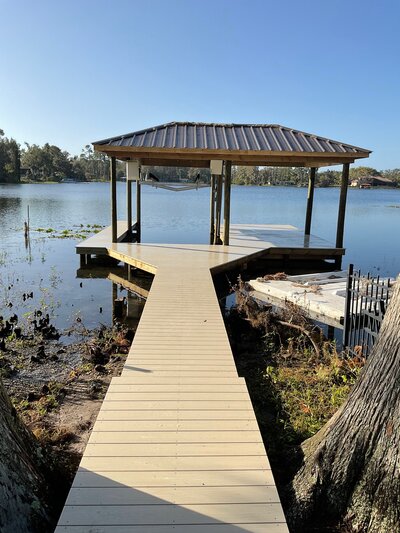
Building a New Dock in Florida
- FDEP: Almost always required — Environmental Resource Permit or exemption verification
- USACE: Required if the dock extends into navigable waters — typically a Nationwide Permit
- Local: County and municipal building permit required
- May also need: Consent of Use for state-owned submerged lands
Seawall Construction or Repair
- FDEP: Required for new seawall construction; repairs may qualify for exemption depending on scope and footprint
- USACE: Required if located adjacent to or in navigable waters
- Local: Building permit required; note that some counties (like Broward) now enforce raised seawall cap standards tied to post-hurricane flood elevation requirements
Dredging
- FDEP: Almost always required; this is one of the most scrutinized permit categories
- USACE: Required – ocean disposal of dredged material is also regulated under the Marine Protection, Research, and Sanctuaries Act (MPRSA)
- Timeline: 6 to 18 months for larger dredging projects; early agency engagement is essential
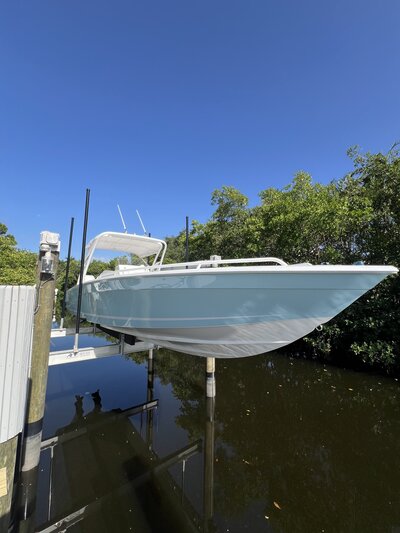
Boat Lift Installation
- FDEP: Often requires a permit or exemption verification, depending on whether it alters the structure’s footprint
- USACE: May apply if the lift platform extends into navigable waters
- Generally: One of the faster permit scenarios, but still requires proper submission to avoid delays
Living Shoreline or Nature-Based Shoreline Stabilization
- FDEP: Now has a dedicated, streamlined permitting pathway under Florida’s 2026 SB 302 legislation
- USACE: Nationwide Permit 54, created specifically for living shoreline projects in 2017
- This is one of the fastest-growing permit categories in Florida as nature-based coastal protection becomes increasingly common — and newly incentivized by state law
How Long Does Marine Environmental Permitting Take?
The honest answer: it depends on the project type, the agencies involved, and how complete your application is on the first submission. Here are realistic benchmarks:
| Permit Type | Typical Timeline |
| FDEP Exemption Verification | 2–4 weeks |
| FDEP General Permit | 4–8 weeks |
| FDEP Standard (Individual) Permit | 3–12 months |
| USACE Nationwide Permit | 4–8 weeks |
| USACE Individual Permit | 6–18 months |
| Combined FDEP + USACE (typical dock) | 6–12 weeks |
| Complex dredging (all agencies) | 12–18+ months |
The most common cause of delays: incomplete applications. Missing surveys, unsigned engineering plans, or incorrect agency forms trigger a Request for Additional Information (RAI) — which pauses the clock and effectively restarts the review. An experienced marine environmental and permit consultant submits complete, accurate applications the first time, significantly reducing RAI risk.
What Does a Marine Environmental Consultant Actually Do?
If you’ve never worked with a marine environmental consultant before, here’s exactly what they handle — and why it matters for your project’s timeline and budget.
- Jurisdictional review: Determines which agencies have authority over your specific project and parcel before any applications are filed
- Agency coordination: Acts as your single point of contact with FDEP, USACE, Water Management Districts, and local building departments
- Application preparation: Assembles all required documents: surveys, engineering plans, biological assessments, site photos, and agency-specific forms
- Benthic surveys: Coordinates seagrass and coral surveys during the FDEP growing season (April 1 – September 30) to avoid calendar-driven delays
- RAI response: Handles agency Requests for Additional Information quickly and accurately, keeping the review moving forward
- Weekly status updates: Keeps you informed on every active permit without requiring you to chase agencies directly
- After-the-fact permits: Resolves unpermitted or non-compliant structures, which is especially common on properties purchased with existing waterfront improvements
A marine infrastructure consultant adds value not just in knowing the rules — but in knowing how each agency operates, what reviewers flag, and how to structure an application that moves through approval with minimal friction.
Why Breezy Permits for Your Florida Marine Project
Breezy Permits is a Florida-based marine permitting firm specializing in dock, seawall, boat lift, dredging, and code violation permits across Palm Beach County and throughout the state.
- Handles FDEP, USACE, SFWMD, LWDD, and local permit submissions in-house
- Underwater drone inspections and certified dive team for pre-permit property assessments
- Dedicated permit coordinator assigned to every project with weekly status updates
- Experienced in after-the-fact permitting and code violation resolution
- Serves waterfront homeowners, marine contractors, and real estate developers
Whether your project is a simple boat lift or a complex seawall replacement requiring coordination across four agencies, Breezy Permits handles every piece, so your project moves forward without delays, surprises, or regulatory blind spots. Visit our contact page to get started.
Frequently Asked Questions
Do I need an FDEP permit to repair my existing dock in Florida?
It depends on the scope. Minor repairs — like replacing damaged decking boards without expanding the dock’s footprint — may qualify for an exemption. However, any work that alters the structure’s size or layout typically requires a permit. Always verify with a marine environmental consultant before starting work, as unauthorized modifications are treated the same as unpermitted construction.
What is Nationwide Permit 54?
NWP 54 is a USACE permit created in 2017 specifically for living shoreline projects — nature-based shoreline stabilization approaches using oyster reefs, native vegetation, or hybrid systems. It streamlines federal authorization for qualifying small to moderate projects and typically runs alongside FDEP’s own exemption or general permit pathway.
Does Florida’s SB 302 (2026) change how living shorelines are permitted?
Yes. Florida’s newly signed SB 302 establishes a dedicated, streamlined FDEP permitting track for nature-based coastal resilience projects, including living shorelines. It also directs FDEP to develop clearer guidelines for newer technologies like 3D-printed reef-mimicking seawall systems. If you’re considering a living shoreline, this is the best time to pursue it — the regulatory environment is actively improving.
How much does marine environmental permitting cost in Florida?
Agency application fees are generally modest. The larger cost is in preparing a complete application: surveys, sealed engineering plans, benthic assessments, and agency coordination. A simple dock permit might run a few thousand dollars all-in. A complex dredging permit with multiple agencies can be significantly more. Breezy Permits provides transparent cost estimates upfront so there are no surprises.
What happens if I build a dock or seawall without a permit in Florida?
You risk stop-work orders, civil fines, and mandatory removal of completed structures at your own expense. Unpermitted waterfront structures also create major issues when selling property — title companies and buyers’ attorneys increasingly require permit verification on all waterfront improvements. After-the-fact permitting is possible but always more costly and time-consuming than permitting correctly from the start.
Can I submit my FDEP and USACE applications at the same time?
Yes — and you should. Submitting simultaneously rather than sequentially is one of the most effective ways to reduce your total permitting timeline. A marine infrastructure consultant will typically prepare and submit all agency applications at the same time, then track each one in parallel.
Ready to Make Permitting a Breeze?
Let’s Take the Stress Out of Your Next Marine Construction Project
From simplifying the permitting process to managing every detail, Breezy Permits is here to save you time, reduce frustration, and get your project moving. Whether you’re tackling a dock installation, seawall repair, or any other waterfront project, we’re ready to help.
OR