July 20, 2026
Broward County Docks, Seawall & Boat Lift Permit Guides 2026
By Ileen Gonzalez
Who actually approves your waterfront project, how long it really takes, and the mistakes that quietly slow everything down.
If you own waterfront property anywhere in Broward County, your dock, seawall, or boat lift is probably going to need attention at some point either this year or sometime soon. Broward has more canal frontage than almost anywhere else in the state, and Fort Lauderdale is known as the Venice of America for good reason. With all of that waterfront comes a question property owners ask constantly: who actually approves this, and how long is it going to take.
Broward County has more canal frontage than almost anywhere else in the state, and property owners regularly need dock permits, seawall permits, or boat lift permits before work can move forward. Depending on the project, approvals may also involve marine construction permitting, environmental permitting, and coordination with local and state agencies.
The honest answer depends on where your property sits, what you are building or repairing, and which agencies get triggered along the way. Understanding that pattern is what actually saves you weeks and sometimes even months, so here is how it works in practice.
How Permitting Actually Works in Broward
For most waterfront projects in Broward, your environmental approvals come from three places, and in many cases they can all be coordinated through the same county process.
The first is your Broward County license, and the county issues two of them for environmental projects. Which one you need comes down to the scope of your work. The Environmental Resource General License, or GL, covers projects with minimal environmental impact, such as installing a seawall 12 inches waterward of the mean high water line, replacing a dock under 500 square feet, or installing a boat lift. Anything that falls outside those criteria moves into the Environmental Resource License, or ERL.
The second is your state approval from the Florida Department of Environmental Protection, better known as FDEP. Here the tier depends on the square footage and the sensitivity of the site, so your approval usually lands in one of three places. Smaller, simpler projects qualify for an exemption, mid range work falls under a general permit, and larger or more complex projects
move into an individual permit with a longer review.
The third is your federal approval from the U.S. Army Corps of Engineers. When your property sits more than 300 feet from a federal channel, that federal authorization can usually be issued through the state process on the Army Corps’ behalf, which is exactly why all three approvals tend to move together through Broward County. Properties closer than that, or right along the Intracoastal Waterway, go through a more direct Army Corps review that adds time to the schedule.
Now, once those environmental approvals are in hand, you are still not quite finished. Broward has roughly 17 tidally influenced municipalities, and each one runs its own building department, its own waterway ordinance, and in some cases its own marine advisory board that weighs in before a permit is issued. So the real first step in any Broward marine project is not picking a contractor. It is confirming which jurisdiction your property actually falls under, because that single answer shapes everything downstream.
Dock Permits: What You Actually Need
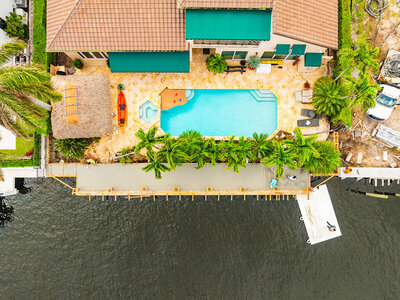
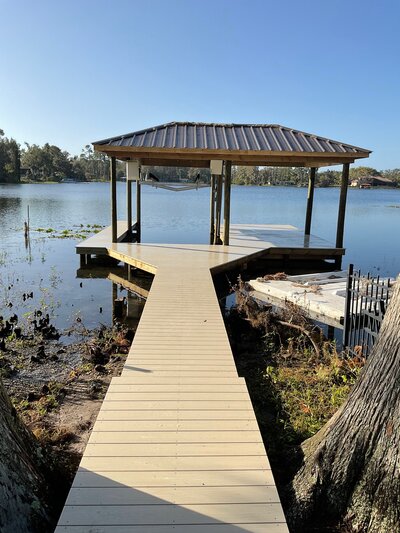
A typical residential dock in Broward runs through a full stack of approvals before construction begins. For most projects, that includes:
- Your Broward County license, either a GL or an ERL depending on the scope of work
- Your FDEP permit, whether that is an exemption, a general permit, or an individual permit
- Your U.S. Army Corps of Engineers authorization
- Your local building permit from the municipality
On site, the state sets the outer boundaries, and the tier of FDEP approval you need scales with the square footage of over water area. For most Broward canals, which sit outside Outstanding Florida Waters, a single private dock up to 1,000 square feet of over water area can qualify for an exemption rather than a full permit. In Outstanding Florida Waters or an aquatic preserve, that exemption threshold drops to 500 square feet and the design criteria get stricter.
From there, a dock up to 2,000 square feet moving no more than two vessels generally falls under a general permit, and anything larger, commercial, or more environmentally sensitive moves into an individual Environmental Resource Permit with a longer review. One detail that trips owners up: FDEP counts roofs, boat cover canopies, elevated platforms, and decking toward that over water total, so a dock that feels small on paper can land in a higher tier once the roof is included.
Beyond the state numbers, Broward layers on its own canal rules. Because so much of the county is built along narrow artificial canals connected to the Intracoastal, your dock and moored vessel combined generally cannot extend more than about 30 percent of the way across the canal, measured from your property line. In a 100 foot wide canal, that caps your extension at roughly 30 feet.
On narrower interior canals, several cities cap extension at a flat 5 feet regardless of that percentage, which surprises owners planning a larger platform than the canal can actually support. Side setbacks layer on top of that, typically 5 to 10 feet of clearance from each property line, and they vary by neighborhood and sometimes by street.
City by city, the details shift further. Fort Lauderdale applies its own setback and length standards through its waterway ordinance, and unusual configurations may go before its marine advisory board first. Hollywood and Pompano Beach each maintain their own canal width and projection limits, so a design approved in one city can come back with revisions in the next. Dania Beach and Deerfield Beach have a fair number of older, nonconforming docks that predate current setback rules, which means replacements or expansions often need a variance in addition to the standard permit.
Seawalls: Where Repair Quietly Becomes Replacement
Seawalls cause more confusion than docks or lifts because owners assume a repair is simpler than it turns out to be. Under Broward’s resiliency code, any substantial repair triggers a full replacement. Substantial repair means work along more than 50 percent of your shoreline length, or appurtenant work that exceeds 50 percent of the cost of the flood barrier along your shoreline. Once you cross that threshold, the entire wall has to be rebuilt along your full shoreline, which brings a structural review, an engineer of record, and FDEP and Army Corps review when the work touches the waterway.
That 50 percent figure is worth watching closely, because it is measured against the total wall, not just the section you set out to fix. A project that starts as patching the worst area can cross into full replacement territory once an engineer opens things up and finds more deterioration behind the cap than expected, so it is worth budgeting for that possibility before construction starts.
A full replacement also has to be brought up to current elevation. NAVD88 is the North American Vertical Datum, the standard reference used to measure elevation. Broward’s countywide minimum tidal flood barrier elevation is 5 feet NAVD88. Applications submitted before January 1, 2035 may be permitted at a minimum of 4 feet NAVD88, as long as the wall is designed and built to accommodate 5 feet by 2050. If your existing wall predates these standards, the new one has to meet current elevation rather than match the old one, which can affect grading and drainage.
There is one more requirement that catches owners off guard. Under the county code, all new and substantially repaired tidal flood barriers must be constructed with natural lime rock riprap, or another approved habitat enhancement, at the waterward face of the structure. So when you replace a wall in Broward, riprap is not an optional add on. It is built into the design from the start, and it happens to bring real ecological value to your shoreline along the way. We have covered Broward’s broader resiliency standards in more depth in a separate piece on our Insights page.
Now, one final wrinkle. A number of Broward canals are bordered by public rights of way, meaning the land between your property line and the water is technically city or county owned. When that applies to your seawall, you will need a right of way or private use permit in addition to the standard building permit.
Boat Lifts
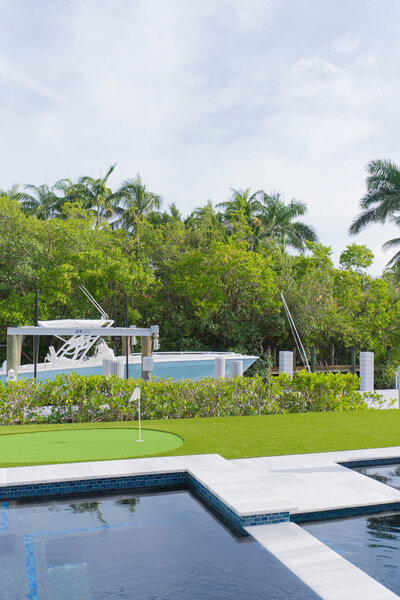
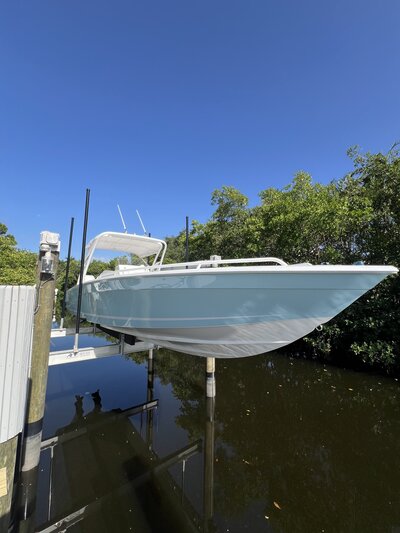
Lifts are usually the simplest of the three, and most qualify comfortably under a General License. Even so, weight capacity and lift height still factor into the local building permit, since taller lifts and canopies can run into view corridor restrictions in cities with dense canal front lots like Hollywood and Fort Lauderdale. The lift motor also needs its own separate electrical permit and inspection, reviewed independently from the structural side.
This is the most common reason lift projects stall right at the finish line: the structural permit closes out while the electrical inspection is still pending. If your community has an HOA, secure that approval before submitting to the city, since most municipalities require it as part of the application packet itself.
Timelines and Cost
Any permit on the water in Broward County can take between three and four months once you account for engineering, environmental approvals, and local approvals working through their sequence. If the property sits along the Intracoastal Waterway or a federal waterway, or if the project also needs approval from the South Florida Water Management District, you can add another month or two to that timeline. None of that includes construction time, only approval.
On cost, local permit fees are typically a percentage of construction value rather than a flat rate, commonly in the range of 3 to 5.5 percent with a modest minimum, though the exact formula is set city by city. The state side is more predictable.
Filing an online self certification of an exemption is free, an exemption verification runs 100 dollars, a general permit is 250 dollars, and an individual Environmental Resource Permit starts at 420 dollars for a single family project. Army Corps authorization usually does not carry a separate fee for residential projects, but it does add review time, which is really the bigger cost for most owners.
Where Projects Actually Get Stuck
The delays we see are almost never about the project itself. They are almost always procedural, and they tend to follow the same handful of patterns. Owners submit to the wrong jurisdiction because the property lines do not match what they assumed. They treat a seawall repair as a repair when it legally qualifies as a replacement. They work from an outdated survey, or they assume a variance will not be needed when older structures rarely meet current setback and elevation standards. On lifts, the electrical permit gets forgotten until the very end, right when everyone expects to be finished.
Before you submit anything, it helps to have the following in hand:
- A current survey
- Confirmation of which jurisdiction your property falls under
- Sealed engineering plans where they are required
- HOA approval, if your community requires it
- A clear answer on whether your seawall project counts as repair or replacement
- A separate electrical permit application queued up for any boat lift
The Bottom Line
Broward rewards preparation more than almost anywhere else in Florida, simply because there are more moving parts. You have a county license layer, a state layer, a federal layer, and then roughly 17 waterfront municipalities each running their own building department and ordinances. Two nearly identical projects on the same canal can follow entirely different paths depending on which side of a city line they sit on.
If you are planning a dock, seawall, or boat lift project anywhere in Broward County and want to know exactly what your specific address requires before you submit anything, reach out to our team. We handle this permitting process daily across the county, and we would be happy to walk you through what your project actually needs. Give us a call at 5615810141.
Ready to Make Permitting a Breeze?
Let’s Take the Stress Out of Your Next Marine Construction Project
From simplifying the permitting process to managing every detail, Breezy Permits is here to save you time, reduce frustration, and get your project moving. Whether you’re tackling a dock installation, seawall repair, or any other waterfront project, we’re ready to help.
OR