June 9, 2026
Florida 9th Edition Code: What It Means for Coastal Construction Permits in 2026
By Ileen Gonzalez
If you own waterfront property in Florida, or if you are a contractor who builds near the water, this is the year to pay close attention. The Florida Building Code is changing, significantly, and the coastal construction implications are some of the most far-reaching updates the industry has seen in years.
The 9th Edition of the Florida Building Code takes effect on December 31, 2026. That deadline is not a soft target. Any coastal construction permit application submitted after that date falls under the new code, full stop. For dock owners, seawall contractors, marine construction firms, and waterfront developers across South Florida, understanding what is changing, and what it means for permits, could be the difference between a smooth project and a costly delay in permitting.
Through this article we breaks it all down.
What Is the Florida Building Code and Why Does the 9th Edition Matter?
The Florida Building Code (FBC) is the state-wide standard that governs how everything gets built in Florida, from single-family homes in Palm Beach County to commercial structures along the Intracoastal. It’s developed by the Florida Building Commission and updated on a three-year cycle, each revision absorbing lessons from storm seasons, updated engineering standards, and changes at the federal and state legislative level.
The 9th Edition replaces the 8th Edition (2023) and is not a minor tweak. It adopts updated national engineering standards, expands wind-resistance requirements along coastal zones, introduces stricter stormwater provisions aligned with FDEP guidance, and responds directly to legislative mandates passed during the 2024–2025 session. For anyone building near tidal water, the changes are material.
The Effective Date and What “Grandfathered” Actually Means
Here’s the practical reality: permits applied for and issued before December 31, 2026 are generally governed by the 8th Edition. Permits submitted after that date must comply with the 9th Edition.
Florida Statute 553.73(7)(e) requires a six-month transition period between code publication and enforcement, and that buffer is already baked into the December 31 effective date. This means if you want coastal construction, Florida dock permitting or construction, seawall replacement, boat lift installation, or marine structure of any kind, the timing of your permit application matters enormously.
If your project requires design changes to meet 9th Edition standards, waiting until January to submit could add engineering costs, revised drawings, new product certifications, and weeks or months to your timeline.
The Big Structural Change: ASCE 7-22 Wind Load Standards
At the engineering level, the single most significant shift in the 9th Edition is the adoption of ASCE 7-22, the American Society of Civil Engineers’ updated standard for minimum design loads on buildings and structures.
What this means in plain terms: the math behind how wind forces are calculated for your structure is changing. Every licensed structural engineer stamping plans for a permit submitted after December 31, 2026 will be working from ASCE 7-22 calculations. If a structure was engineered under 8th Edition assumptions, those calculations may no longer be sufficient for a 9th Edition permit review.
For marine construction, this matters for anything with a structural component, docks with roofed pavilions, covered boat lifts, elevated walkways, and any waterfront structure that presents a wind profile. This does not change the permitting pathway, but it does change what your engineer needs to produce to get through review.
Expanded 160 MPH Impact-Resistant Envelope: Coastal Properties Take Notice
One of the most headline-grabbing changes in the 9th Edition is the expansion of the 160 mph hardened building envelope requirement well beyond its traditional geographic boundaries.
Historically, the High-Velocity Hurricane Zone (HVHZ), encompassing Miami-Dade and Broward counties, was the only area in Florida where 160 mph impact-resistant construction was mandatory for windows, doors, and building envelopes. That’s changing.
Under the new framework, the 160 mph requirement now extends to:
- New residential construction within five miles of tidal waters, statewide
- Multistory R-1 and R-2 occupancies (hotels, condos, apartments)
- All new construction inside the traditional HVHZ (unchanged)
For practical purposes, the five-miles-of-tidal-water rule captures almost every coastal community in South Florida, from Jupiter to Key West, from Tampa Bay to the Treasure Coast. If you are building a new structure on or near the water in Palm Beach County, Martin County, St. Lucie County, or virtually any coastal county in Florida, the new envelope standards likely apply.
What does that mean for your project? Windows, doors, and glazed openings must meet higher design pressure ratings. Products that passed Florida Product Approval under the 8th Edition may need re-evaluation or replacement to meet 9th Edition standards. Your architect and contractor need to know this before finalizing specifications.
FDEP’s CCCL Program: The Parallel Permitting Layer You Can’t Ignore
While the Florida Building Code governs structural design and local building permits, Coastal construction WATERWARD of the CCCL line, administered by the Florida Department of Environmental Protection (FDEP).
Understanding the relationship between these two systems is critical for anyone permitting a coastal project.
What Is the CCCL?
The Coastal Construction Control Line defines the portion of Florida’s beach and dune system subject to severe fluctuations based on a 100-year storm event. It marks the landward limit of FDEP jurisdiction along the sandy beaches fronting the Gulf of America, the Atlantic Ocean, and the Straits of Florida.
Any construction or excavation activity seaward of the CCCL requires a CCCL permit from FDEP, regardless of what local building permits you hold. The CCCL is not a setback line that limits where you can build. It’s a jurisdictional boundary where FDEP evaluates whether your project’s siting and design adequately protect the beach and dune system, neighbouring properties, public beach access, native vegetation, and marine turtles.
The CCCL Program is established under Chapter 161 of Florida Statutes, with implementing rules under Chapter 62B-33 of the Florida Administrative Code.
What Does FDEP Regulate Under the CCCL?
FDEP regulates a wide range of activities seaward of the CCCL, including:
- Construction of new structures
- Modification or expansion of existing structures
- Removal or alteration of native coastal vegetation
- Excavation and grading activities
- Any activity that could destabilize or damage the beach-dune
The CCCL Program covers 25 sandy beach counties in Florida. In counties where no formal CCCL has been established, primarily in Florida’s Big Bend region, a 50-foot setback from mean high water serves as the jurisdictional boundary.
CCCL and the 9th Edition: The Intersection
The 9th Edition’s updated stormwater provisions explicitly align with FDEP permit standards. For coastal projects that require both a local building permit and a CCCL permit, this alignment is meaningful, it reduces inconsistency between what local building departments require and what FDEP expects in terms of drainage, runoff, and environmental protection.
For developers, contractors, and property owners, this means projects previously caught between conflicting agency requirements may find the 9th Edition a slightly smoother regulatory environment, but only if applications are submitted correctly and both agencies are engaged from the start.
FDEP and USACE for Marine Permitting
Coastal construction in Florida, particularly marine work like docks, seawalls, boat lifts, and dredging, almost always involves two federal and state agencies beyond the local building department, know when to which one to choose from FDEP and USACE:
Florida Department of Environmental Protection (FDEP)
FDEP regulates seawall construction, dock installations, shoreline modifications, and related coastal work under its Environmental Resource Permitting (ERP) program and the CCCL Program. FDEP evaluates impacts to water quality, wetlands, seagrass, marine habitat, and flood management. The 9th Edition’s stormwater updates directly align with FDEP’s environmental resource permitting criteria, another reason to understand both frameworks before submitting applications.
U.S. Army Corps of Engineers (USACE)
The USACE regulates activities in navigable waters of the United States under Section 404 of the Clean Water Act and Section 10 of the Rivers and Harbors Act. For most standard dock and seawall projects in Florida, this typically means a Nationwide Permit (NWP) rather than an individual permit, but even NWPs require compliance verification and, in many cases, pre-construction notification.
What’s critical to understand: these two agencies do not always operate on the same timeline. FDEP reviews can take weeks to months depending on project complexity. USACE processing adds another layer. And local building permits, now under updated timelines thanks to HB 267, must be acted on within 30 business days for qualifying residential projects. Coordination between all three matters more than any single approval in isolation.
Updated Permit Processing Timelines: HB 267 Changes the Clock
House Bill 267, signed by Governor DeSantis in 2024, revised Section 553.792 of Florida Statutes to set firm deadlines on permit processing:
- Local governments must approve or deny complete permit applications within 30 business days for single-family residential structures under 7,500 square feet
- 60 business days for non-residential buildings under 25,000 square feet or multifamily projects up to 50 units
- Applications not acted on within these windows may be deemed approved by default
For waterfront property owners, this is meaningful, but the operative word is complete. Incomplete or deficient applications reset the clock and do not qualify for the default approval provision. This reinforces something experienced permit consultants have known for years: the quality and completeness of your application at submission is the single biggest factor in how quickly you get approval.
What This Means for Dock, Seawall, and Boat Lift Permits
Dock Permits
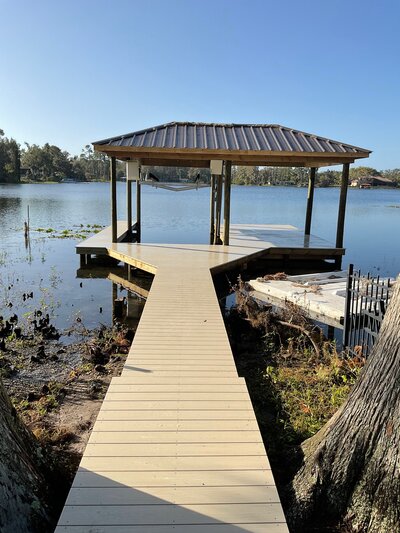
Dock permits in Florida require coordination between local building departments: FDEP, and potentially USACE. Under the 9th Edition, roofed or covered dock structures within five miles of tidal water will be subject to ASCE 7-22 wind load calculations and, if applicable, the 160 mph envelope requirements for any enclosed portions. Engineering drawings must reflect updated wind load maps. For straightforward open-deck residential docks, the direct impact may be limited, but any dock with a roof, covered boat lift, or enclosed structure should expect updated engineering requirements for 2027 and beyond.
Seawall Permits
Seawall construction and replacement permits in Florida requires local building permits (sealed drawings, licensed marine contractor), FDEP shoreline modification review, and in some cases USACE authorization. Under the 9th Edition, structural design elements, particularly tie-back systems, cap designs, and above-grade structures connected to the seawall, must comply with ASCE 7-22. FDEP’s updated stormwater alignment also means drainage from upland areas into seawall structures may receive closer scrutiny.
Boat Lift Permits
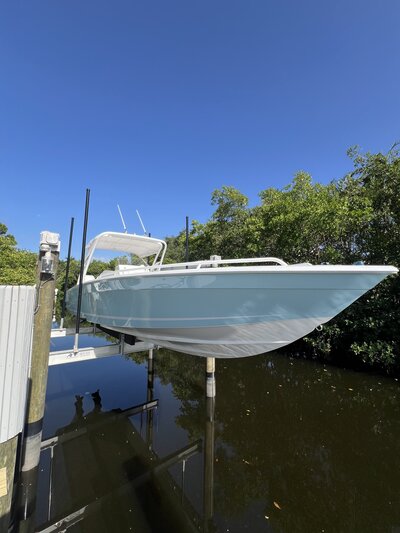
Boat lift permitting is often the most underestimated part of a marine construction project. Under the 9th Edition, any enclosed or roofed boat lift structure falls under the expanded impact-resistance provisions if it is within five miles of tidal water, which virtually all of them are. Open boat lifts without structural enclosures have less direct exposure to the new envelope requirements, but the underlying ASCE 7-22 structural standards still apply to the lift’s anchoring and support systems.
The Permit Window You Need to Know About
There are two windows to understand:
Before December 31, 2026: Applications submitted and permits issued before this date are governed by the 8th Edition. If your project is designed and ready to go, submitting now locks in current code standards and avoids the need to redesign for 9th Edition compliance.
After December 31, 2026: All new permit applications must comply with the 9th Edition. If your design was engineered under 8th Edition assumptions, particularly for wind loads, impact resistance, or stormwater, revisions may be required before your application is accepted.
Ready to Get Ahead of the 9th Edition Changes?
At Breezy Permits, we specialize in marine and coastal construction permitting throughout Florida, docks, seawalls, boat lifts, dredging, and more. We handle FDEP, USACE, and local building permit coordination so your project moves forward without getting stuck in the regulatory maze. If you have a coastal project in the works for 2026 or 2027, now is the time to start the permitting process. The December 31, 2026 code transition is real, and the projects that come through it smoothly will be the ones that planned ahead.
Ready to Make Permitting a Breeze?
Let’s Take the Stress Out of Your Next Marine Construction Project
From simplifying the permitting process to managing every detail, Breezy Permits is here to save you time, reduce frustration, and get your project moving. Whether you’re tackling a dock installation, seawall repair, or any other waterfront project, we’re ready to help.
OR